Sea Animal Doodles: A Playful Asset for Creative Projects
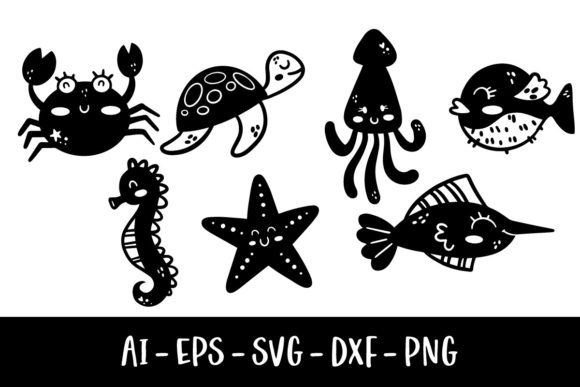
When you're building a brand or a classroom resource that needs to connect with a younger audience or evoke a sense of fun, standard corporate imagery often falls flat. That’s where a specific style of design assets comes into play. I recently worked with a set of Sea Animal Doodles, and it struck me how effective this type of illustration is for specific market segments. This isn't just a random collection of drawings; it is a cohesive set of seven distinct sea creatures—a crab, a turtle, an octopus, a fish, a seahorse, a starfish, and a swordfish—designed to inject personality into educational and creative materials.
The visual style here is best described as hand-drawn and organic. Unlike rigid vector graphics that feel sterile, these doodles have a warmth that mimics actual pen strokes. This approach to modern typography and illustration is trending because it humanizes digital content. For designers, the appeal lies in the versatility of the line work. They function similarly to a display font or handwritten font, grabbing attention without overwhelming the layout. Because the set includes PNG, SVG, EPS, DXF, and AI files, you aren't limited to just digital screens. You can scale these up for signage or down for stickers without losing quality, which is a non-negotiable requirement for professional logo design or packaging design.
Integrating Sea Animal Doodles into Brand Identity and Marketing
For small business owners and entrepreneurs, particularly those in the children’s education sector, toy manufacturing, or family-friendly hospitality, consistency is key. You want a brand identity that feels approachable. Using Sea Animal Doodles across your touchpoints—from your website headers to your email marketing footers—creates a recognizable visual language. Imagine a swim school using the swordfish as a recurring mascot element on their registration forms and the octopus on their social media announcements. This creates a cohesive narrative that builds trust.
When considering web design, these illustrations work exceptionally well as background textures or "hero" section accents. They break up the monotony of text-heavy pages. However, a word of caution on readability: because these are detailed illustrations, they should never compete with your primary text. Use them as decorative elements in the margins or as large, watermark-style background images behind your sans serif font or serif font choices. If you place them too close to your body copy, you risk creating visual noise that distracts the reader.
Practical Applications for Content Creators and Crafters
Beyond traditional branding, the utility of this set extends deeply into the crafting community. If you are a hobbyist or a seller on platforms like Etsy, the inclusion of DXF files is a massive advantage. This format is standard for cutting machines like Cricut or Silhouette. You can turn these doodles into vinyl decals for car windows, stencils for painting tote bags, or iron-on transfers for t-shirts. The octopus and turtle, in particular, have enough detail to look impressive on physical merchandise but are simple enough to weed easily when cutting vinyl.
For digital publishers and bloggers, think about how these assets can enhance editorial design. If you run a travel blog or a parenting site, generic stock photos often feel disconnected. Creating custom graphics using Sea Animal Doodles adds a layer of authenticity that resonates with readers. You could use the starfish as a bullet point icon for lists or the seahorse as a separator between sections. This is a subtle way to maintain visual hierarchy and keep the reader engaged without relying on expensive custom illustration commissions.
Technical Considerations for Professional Use
When evaluating any premium font or asset set, the technical execution matters. One of the strengths of this collection is the variety of file formats. The SVG and EPS formats are crucial for designers working in Adobe Illustrator or Affinity Designer because they allow for full color customization. You aren't stuck with the default black lines; you can adjust the stroke weight or color palette to match your specific font pairing and color scheme.
Speaking of pairings, finding the right typography to accompany these doodles is essential. Because the illustrations are playful and organic, they pair best with fonts that share similar traits. A rigid, geometric sans serif might feel too cold next to a hand-drawn crab. Instead, look for a script font or a rounded, friendly typeface. This creates a harmonic balance in your layout. If you are designing a worksheet, for instance, pair the doodles with a legible, large x-height sans serif font for the questions, ensuring that the educational content remains the primary focus while the doodles provide the thematic context.
Finally, always consider the licensing implications for commercial work. While these assets are fantastic for social media graphics and packaging design, ensure you understand the terms if you plan to sell the finished product (like a printed t-shirt) versus using it for marketing (like a Facebook ad). The value of a creative font or asset lies not just in its aesthetic but in its legal flexibility. With the right application, these Sea Animal Doodles can elevate a project from generic to memorable, providing that "hand-made" touch that audiences increasingly crave in a digital-first world.